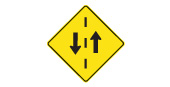
Two-way traffic (share with oncoming)
Official Ontario sign code: Wa-37
What this sign means
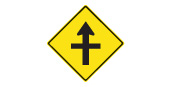
Two-way traffic (share with oncoming) is an official Ontario warning sign. Warning signs prepare drivers for a condition ahead, so the safe response is usually to slow down, scan, and be ready to adjust. It is listed with Ontario code Wa-37.
What to do
Reduce speed if needed, check mirrors and blind spots, and prepare for the hazard or road shape shown on the sign. Slow if conditions require it, scan ahead, check mirrors, and leave yourself time to adjust before the hazard or road change.
G1 study tip
For the G1 test, warning signs usually ask what hazard is ahead and what safe adjustment the driver should make. On the G1 test, expect the correct answer to identify the hazard ahead and the safe adjustment.
Sign images are sourced from the Official MTO Driver's Handbook under the Open Government Licence, Ontario, or from Wikimedia Commons public domain files with Ontario sign-code source matching. The fire route example uses an official Ontario municipal source.
How to Recognize and Use This Sign
Use these study notes to connect the sign image with the action expected on Ontario roads and on the G1 test.
Where you will see it
You usually see it before a road hazard, crossing, curve, hill, lane change, or traffic condition that needs extra attention. For Two-way traffic (share with oncoming), look at the sign shape, symbol, text, and any posted times or lane arrows before deciding what to do.
Common mistake
A common mistake is waiting until the hazard is directly beside the vehicle before reacting. For Two-way traffic (share with oncoming), the safe answer is usually the one that obeys the posted sign early and leaves room for other road users.
Example on the road
If traffic is moving quickly and this sign appears ahead, ease off the accelerator early and look for the condition shown by the sign. Use the Two-way traffic (share with oncoming) sign as the main clue for what the examiner expects you to recognize.
Memory cue
Warning signs are early notice signs. First ask what could happen ahead. For Two-way traffic (share with oncoming), connect the visual symbol to the driver action before reading the answer choices.
Two-way traffic (share with oncoming) FAQs
What does the Two-way traffic (share with oncoming) sign mean in Ontario?
Two-way traffic (share with oncoming) is an official Ontario road sign. The key idea is: Two-way traffic (share with oncoming) is an official Ontario warning sign. Warning signs prepare drivers for a condition ahead, so the safe response is usually to slow down, scan, and be ready to adjust.
What should I remember about Two-way traffic (share with oncoming) for the G1 test?
For the G1 test, warning signs usually ask what hazard is ahead and what safe adjustment the driver should make. Also remember the practical driver response: Reduce speed if needed, check mirrors and blind spots, and prepare for the hazard or road shape shown on the sign.

Practice every sign with a real instructor.
Book a lesson with SafePass and learn every Ontario road sign on the road, not just in a study guide.